
How to choose the trim size, paper and binding of your book
Pocket paperback, novel, technical book or art book: which trim size, paper, binding and finishes suit your book? Advice from IN TEMPO.
By Yvan Cardona
Published on
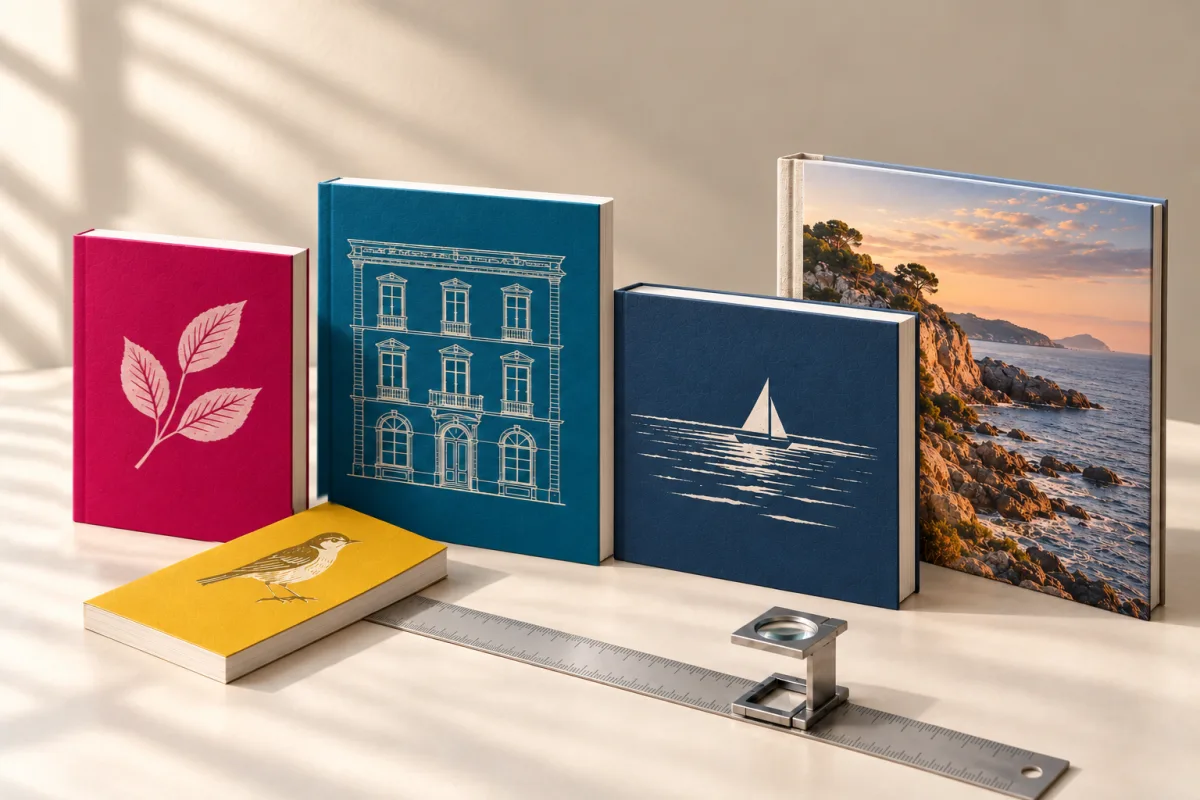
Is it a novel, a technical book, a practical guide, a book of photographs?
With our 30 years of experience, we will help you choose the right options, and we will also share our own tastes and some of the advice we have given to publishing houses.
1. How to choose the trim size of a book (A5, A4, square and so on)
To keep costs down and to be able to approach a large number of printers, stick to the standard sizes.
- 10.8 × 17.8 cm for pocket paperbacks.
- 14.8 × 21 cm for novels and essays (our own favourite is 14 × 19 cm).
- 16 × 24 or 17 × 25 cm for technical books.
- 22 × 28 cm or 24 × 30 cm for art books and books of photographs.
Square sizes, 17 × 17 cm or 21 × 21 cm, are very appealing, but they waste more paper, and that raises the manufacturing cost.

2. Once the size is set, which paper should I choose?
For pocket paperbacks, most publishers use wood-containing papers in low weights such as 49 or 52 gsm.
Novels, biographies, essays and poetry go rather on white or cream high-bulk paper at 70, 80 or 90 gsm, with a bulk between 1.5 and 2. Remember what we said in our previous article: the bulk of the paper largely decides how thick the book will be.
Technical books, practical guides and even school books are usually printed on white offset paper at 80 or 90 gsm. They often carry illustrations, drawings, diagrams and a second colour, so 90 gsm is better, for more opacity.
Art books and books of photographs go on gloss, silk or matt coated paper. At IN TEMPO, we love cookbooks and photo books printed on offset paper! Less bright, admittedly, but more on trend.
3. Perfect bound, sewn or hardback?
It has to be said that, with the progress made in glues, most of the books you will find in a bookshop are perfect bound.
Hot-melt and PUR glues are very strong, even for daily handling.
Be careful all the same with a small-format book that has few pages: readers tend to force it open to read more comfortably, and they often “break” the spine.
Sewing is still the strongest way to bind a paperback, but it costs more, because many printers cannot sew when they print digitally.
Hardback binding, with a square or rounded spine, 2.4 mm (24/10) boards or Intégra binding, for dictionaries, art books and so on. A dust jacket can be added as well.
On the covers of paperbacks, perfect bound or sewn, you can also choose handsome flaps, which leave room for more information, the author’s photo or anything else, or a gloss spot varnish over matt lamination to make one element of the cover stand out (the title, the author’s name, your publishing house’s logo, an important photograph).
A little more complex and more expensive: foil stamping, embossing or debossing.
For some years now, sprayed edges, in one colour or with patterns, have been enjoying renewed interest in fantasy, science fiction and romance. They are hard to do on small runs, because they are still expensive and very few printers in France offer them.
We will be back soon with more tips on printing and making books!
In the glossary
Your book, now: trim size, paper, binding.
Prepare your specification