
Choosing the paper for your book: high-bulk, offset or coated?
High-bulk, offset or coated paper, weight, bulk, format and print run: how to choose the paper for your book to suit your project, your budget and your vision.
By Yvan Cardona
Published on
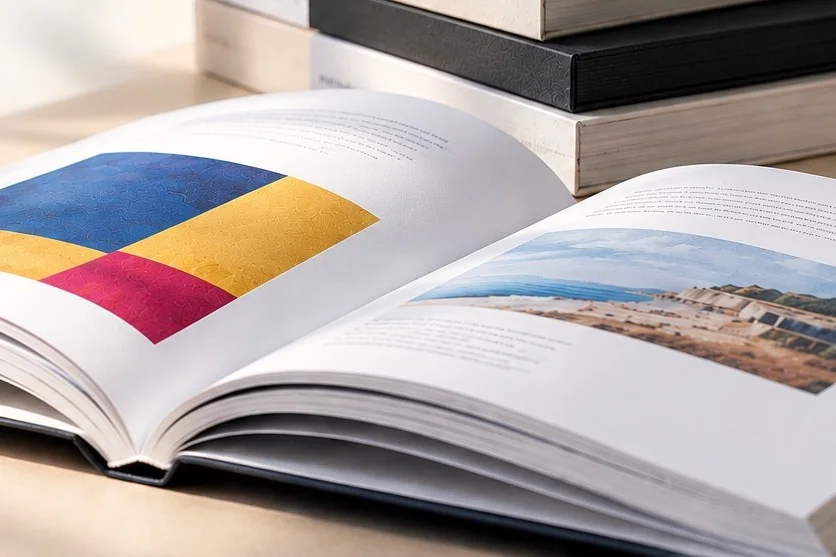
You are getting your book ready for print and wondering which paper to choose? That is an excellent question!
Paper is far more than something to print on: it sets the tone, the texture and the identity of your book. Between a white or cream high-bulk paper, an offset paper or a coated paper, the differences matter.
As a rule, offset and coated papers are not sold by bulk, whereas the bulk of a high-bulk paper can range from 1.3 to 2.
Remember that bulk is what makes a book thick. For example, a 240-page book on 80 gsm high-bulk paper with a bulk of 1.8 will have an 18 mm spine, whereas on 90 gsm offset paper the spine will be 14 mm: almost half a centimetre of difference for the same number of pages!
High-bulk paper is the most suitable for novels and essays; offset paper for technical, legal and even school books; and coated paper for art and photography books.
For some years now we have seen many illustrated cookbooks printed on offset rather than coated paper, which gives them a more modern feel.
At IN TEMPO, we help authors, publishers and self-published projects make this important decision every day. In this article, we explain how to choose the ideal paper for your book according to your project, your budget and your vision.
1. Understanding the types of printing paper
Choosing a paper starts with understanding the three main families.
Coated: gloss, silk or matt
This paper gives a bright, contrasted result. It is the ideal choice for:
- photography and art books;
- children’s picture books;
- catalogues;
- illustrated books.
High-bulk papers
Ideal for:
- novels and general literature;
- essays;
- biographies.
Advantages: comfortable to read, elegant, a wide choice of weights and bulks.
White or cream offset
Offset (uncoated) paper is ideal for:
- technical books;
- legal books, often on a very light paper (50 or 60 gsm);
- school books.
Cream offset is widely used by large-print publishers (16 pt type), because its shade is more restful for the eyes and less harsh over a long read.
2. Paper weight: which weight for which book?
Paper weight is expressed in g/m² (grams per square metre), or gsm.
Common weights:
- high-bulk: 70, 80 or 90 gsm, with a bulk of 1.5, 1.8 or 2;
- offset: 80 or 90 gsm, with a bulk of 1.2 to 1.3;
- gloss or matt coated: from 80 to 150 gsm depending on the images. Art books are often on 135 or 150, or even 170 gsm, whereas catalogues and brochures are more often on 80, 90 or 115 gsm.
For novels and general literature up to 256 pages, the preference goes to white or cream high-bulk papers at 80 gsm with a bulk of 1.8 or 2, depending on the printer’s stock, to give the spine some thickness; beyond that, a bulk of 1.5, so that the spine does not get too thick.
3. Book formats
The format sometimes decides the paper:
- pocket format (10.8 × 17.8 cm): thin papers (52 to 55 gsm), which make the book supple, light and less expensive. This is the format of French pocket imprints such as Livre de Poche, Folio, Pocket and 10/18;
- standard format (14 × 21 cm): much in demand; every paper works with it, though high-bulk paper predominates;
- large format (17 × 24 cm or A4): often white offset papers (90 to 120 gsm);
- square format: needs a paper with some body (100 gsm minimum).
4. Print run: digital or offset printing
Digital printing appeared in the early 1990s. The technology printed only black text, and neither the print quality nor the binding was fully mature. Offset printing dominated printing and publishing, because the average print run was around 1,500 or 2,000 copies.
Over time, new players arrived on the market with faster, more reliable equipment. Some printers have specialised and do nothing but digital printing, in black and in colour.
Digital web presses have become more and more common in printing works, so that the break-even point with offset printing, in terms of cost, now lies at 3,000 copies.
Printing this way keeps distributors’ stock down, which considerably reduces publishers’ costs.
And let us not forget print on demand (POD) for runs of fewer than 10 copies.
5. Responsible paper: an obvious choice
The principles and criteria of the FSC and PEFC standards set out management rules so that forests meet the social, economic, ecological, cultural and spiritual needs of present and future generations.
These principles cover respect for the law, working conditions and workers’ rights, the rights of indigenous peoples, and environmental values and impacts.
Today it is almost unthinkable to print on papers that do not meet the FSC or PEFC standards.
There are also bio-based papers that combine alternative fibres such as straw or hemp, but for now that market is tiny for book publishing: these papers are expensive and hard to source.
6. Our advice for choosing well
Your checklist before deciding:
- Define your book’s genre (literature, technical, photography, children’s book, etc.).
- Estimate your print run (small: digital; large: offset).
- Test: order samples of three or four different papers from the paper merchants’ websites (no longer free, but at a reasonable cost).
- Touch the papers: it is decisive!
- Ask a professional: your printers often have half a century of experience.
- Think about the consistency of your project: the cover paper and the text paper should belong together.
- If the rendering of the photographs is essential, approve the colours with digital proofs before the final run.
At IN TEMPO, we help you make this decision free of charge. Our experts have been printing for more than 30 years and can advise you on the ideal paper.
Still unsure? Ask for a free consultation. We will help you create the book you have in mind.